When you think of basketball greatness, certain names immediately come to mind. Among them stands Dirk Nowitzki, the 7-foot German sharpshooter who not only dominated the NBA for over two decades but fundamentally changed how the game is played. His journey from a skinny kid in Würzburg to a global icon is a story of perseverance, innovation, and unwavering loyalty. This article explores the life, career, and enduring legacy of the man who proved that a big man’s game could be beautiful. Dirk Nowitzki didn’t just play basketball; he redefined it, inspired millions, and left a mark on the sport that will never fade.
From Würzburg to the World Stage: The Early Years
Dirk Werner Nowitzki was born on June 19, 1978, in Würzburg, West Germany. Basketball was in his blood from the very beginning. His mother, Helga Nowitzki, was a professional basketball player who represented the West German national team. His father, Jörg-Werner Nowitzki, was a handball player, so athletics ran deep in the family. However, Dirk was actually a late bloomer to the sport, taking it up seriously at the age of 13. Before that, he played tennis and handball, but basketball eventually captured his heart.
His natural talent was undeniable from the start. Standing tall even as a teenager, Dirk had a unique combination of height and coordination that set him apart. By the age of 16, he was already playing professionally for DJK Würzburg in the German second division. This was where he began to develop the skills that would later make him an NBA legend. His coaches quickly realized they had something special on their hands. He wasn’t just tall; he could shoot, dribble, and pass with a finesse rarely seen in players his size.
The turning point in his journey came in 1998. During an exhibition game in San Antonio, Texas, a 19-year-old Nowitzki scored 33 points, leading a team of international prospects to a victory over a squad of American high school stars. This performance put him firmly on the radar of NBA scouts and executives. He was selected with the ninth overall pick in the 1998 NBA Draft by the Milwaukee Bucks. However, in a move that would change the course of NBA history, he was immediately traded to the Dallas Mavericks. This trade was orchestrated by then-Mavericks coach Don Nelson, who saw something extraordinary in the young German. Nelson famously said that Nowitzki reminded him of a young Larry Bird, a comparison that seemed outrageous at the time but would prove remarkably accurate.
The Dallas Mavericks Dynasty: Building a Legend
Nowitzki’s arrival marked a turning point for the Dallas Mavericks. The team had struggled for years, often being the laughingstock of the league. But with Dirk at the helm, the Mavericks became a perennial powerhouse. In his early years, he faced the typical struggles of a young international player adapting to the NBA. The game was faster, the players were more athletic, and the physicality was on another level. However, Dirk’s work ethic was unmatched. He spent countless hours in the gym, honing his skills and adding strength to his lanky frame.
He led the Mavericks to 15 playoff appearances, a stretch of sustained excellence that few teams in NBA history can match. This included the franchise’s first NBA Finals appearance in 2006 and its only championship in 2011. Dirk was the constant in all of this success. He was the anchor, the leader, and the heart of the team. His individual accolades are staggering and speak volumes about his dominance. He is a 14-time NBA All-Star and a 12-time All-NBA Team member. These selections reflect not just his popularity but the respect he commanded from coaches, players, and media around the league.
One of the crowning achievements of his regular-season career came in 2007 when he won the NBA Most Valuable Player Award. This made him the first European-born player to ever receive the honor. He was also the first player from Europe to lead his team to the NBA Finals and win the Finals MVP award. When he retired, Nowitzki had amassed 31,560 points, ranking sixth on the NBA’s all-time scoring list. He is the highest-scoring foreign-born player in NBA history, a testament to his incredible longevity and consistency. He also holds an incredible record: the longest tenure with a single franchise in NBA history at 21 seasons. In 2023, he was rightfully inducted into the Naismith Memorial Basketball Hall of Fame, cementing his status as one of the greatest to ever play the game.
Revolutionizing the Game: The Unstoppable Fadeaway and His Unique Skillset
Nowitzki wasn’t just a great player; he was a revolutionary one. When he entered the league, the conventional wisdom was that a 7-footer should dominate in the paint, not on the perimeter. Big men were expected to post up, rebound, and block shots. Nowitzki, however, arrived with a deadly shooting touch that defied all conventional thinking. He possessed a skill set typically reserved for guards, combined with the height of a center. This made him a “positionless” player before the term was even popular. He spent most of his career at power forward but was just as comfortable shooting from downtown, where he maintained a career three-point percentage of 38%. He could also put the ball on the floor and drive past slower defenders or pull up for a mid-range jumper.
He helped pioneer the modern stretch-four, paving the way for a generation of big men who could shoot and handle the ball. Today, you see players like Kristaps Porzingis, Karl-Anthony Towns, and Chet Holmgren playing a similar style, but Nowitzki was the original. He showed that a big man didn’t have to be a bruiser in the paint; he could be a finesse player who scored from anywhere on the court.
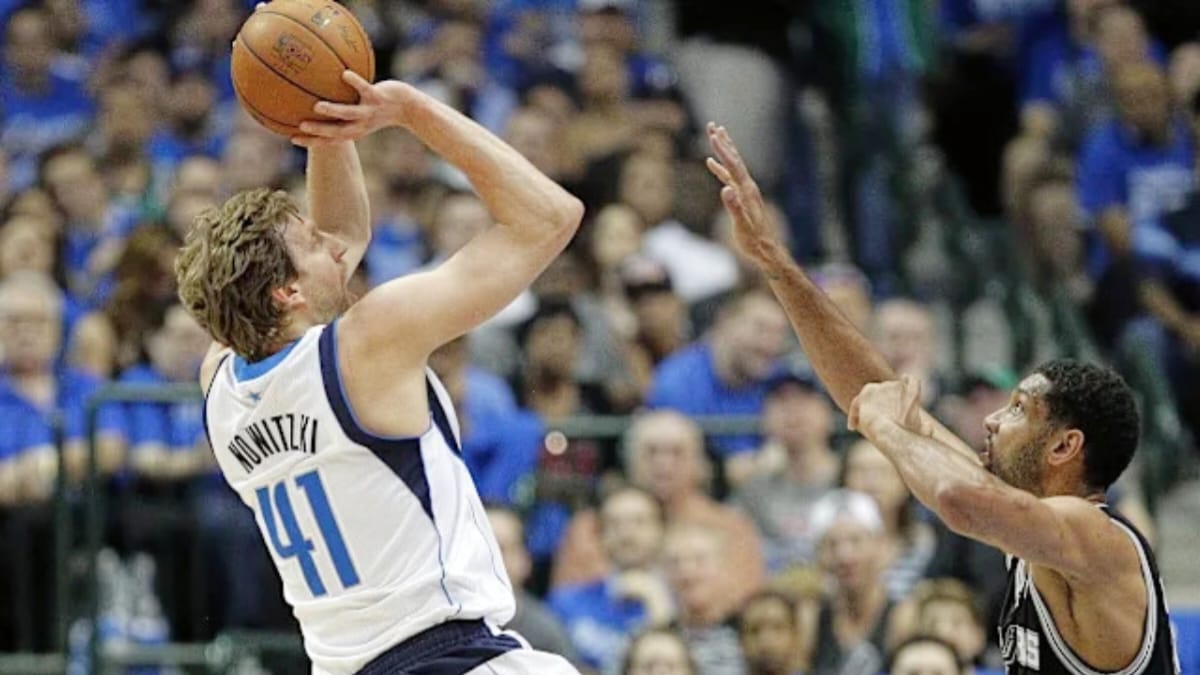
His most famous weapon was his signature one-legged fadeaway jump shot. This move, which he developed with his long-time coach and mentor Holger Geschwindner, was practically unguardable. Geschwindner, a former physics teacher, helped Nowitzki understand the mechanics of the shot, from the angle of release to the backspin on the ball. The move involved Dirk leaping backward on one leg, creating significant space between himself and his defender. Because of his height and the high release point, it was nearly impossible to block. Today, players like LeBron James, Kevin Durant, and Luka Doncic have all added the move to their arsenal, a testament to Nowitzki’s lasting impact on the game. It has become one of the most iconic and replicated shots in basketball history, a signature move that belongs exclusively to the German legend.
The Ultimate Triumph: The 2011 NBA Championship and a Legacy Redeemed
For all his regular-season success, Nowitzki’s legacy was once unfairly overshadowed by playoff disappointments. The 2006 NBA Finals saw the Mavericks blow a 2-0 lead against the Miami Heat, a heartbreaking loss that left a scar on the franchise. The very next year, they were shockingly eliminated in the first round by the Golden State Warriors in one of the biggest upsets in NBA history. Critics labeled Nowitzki as “soft,” a common stereotype for European players at the time. They questioned his ability to lead a team to the ultimate prize. But 2011 changed everything and silenced all the doubters forever.
Nowitzki led a veteran Mavericks team on one of the most remarkable playoff runs in NBA history. They defeated the Portland Trail Blazers in the first round, then swept the defending champion Los Angeles Lakers in the second round. In the Western Conference Finals, they overcame the young and athletic Oklahoma City Thunder. In the Finals, they faced the Miami Heat, a team that was considered the overwhelming favorite. Miami was led by the trio of LeBron James, Dwyane Wade, and Chris Bosh, who had come together with the goal of winning multiple championships.
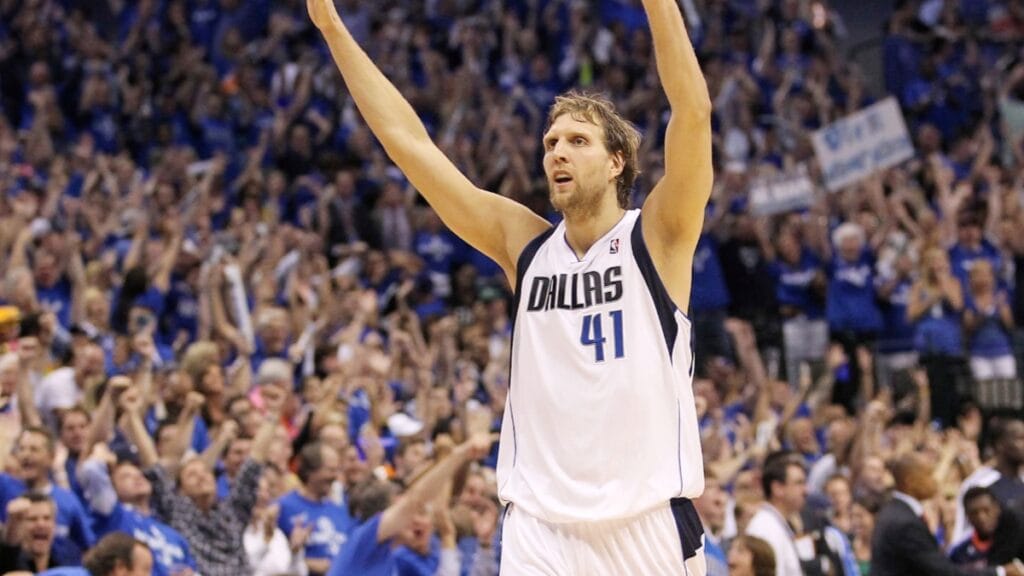
Down 2-1 in the series, Nowitzki took over like a true legend. Playing with a torn tendon in his finger on his shooting hand, he delivered clutch performance after clutch performance. He was absolutely unstoppable in the fourth quarter, averaging 10.3 points in the final period. He hit game-winning shots, grabbed crucial rebounds, and played with a fire that inspired his entire team. The Mavericks won the series 4-2, securing the franchise’s first NBA championship. Nowitzki was named Finals MVP, finally silencing his critics and cementing his place among the all-time greats. This championship run is often cited as one of the greatest individual playoff performances in NBA history, a testament to Dirk’s heart, skill, and unwavering determination.
A Legacy Beyond the Court: The European Pioneer and His Influence
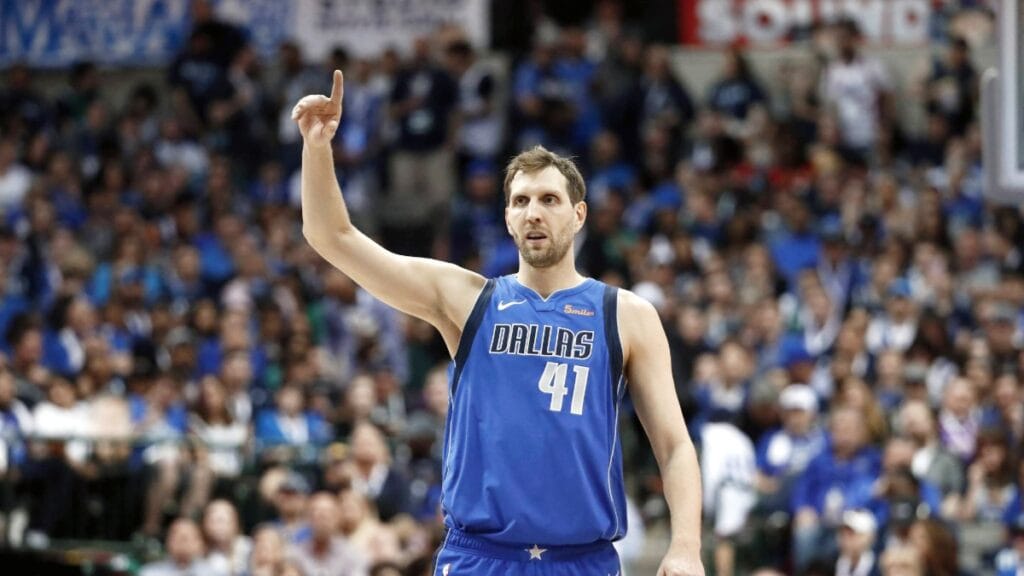
Nowitzki’s impact extends far beyond his statistics and accolades. He is revered for his incredible loyalty to the Dallas Mavericks and the city of Dallas. In an era of player movement and “superteams,” Dirk chose to stay with one franchise for his entire career. His relationship with owner Mark Cuban was legendary, built on mutual respect and a shared desire to win. Cuban often spoke of Dirk as his “brother,” and their bond was one of the most unique owner-player relationships in sports history. This loyalty made him an icon in Dallas, a city that loves its sports heroes. His number 41 jersey was retired by the team, and a statue of him now stands outside the American Airlines Center.
As a European pioneer, Nowitzki’s success opened the door for the influx of international talent we see today. He challenged stereotypes and proved that European players were not “soft” but highly skilled. In a recent 2026 interview, he reflected on his early days, saying, “When we came over there late ’90s, we were tall and we were shooting the ball. That was perceived as soft, but we were skilled.” He helped shift the perception, paving the way for current European superstars like Nikola Jokic, Luka Doncic, and Giannis Antetokounmpo. Without Dirk Nowitzki, it’s hard to imagine the global game being what it is today. He showed young players from Europe, and around the world, that they could not only compete in the NBA but dominate it.
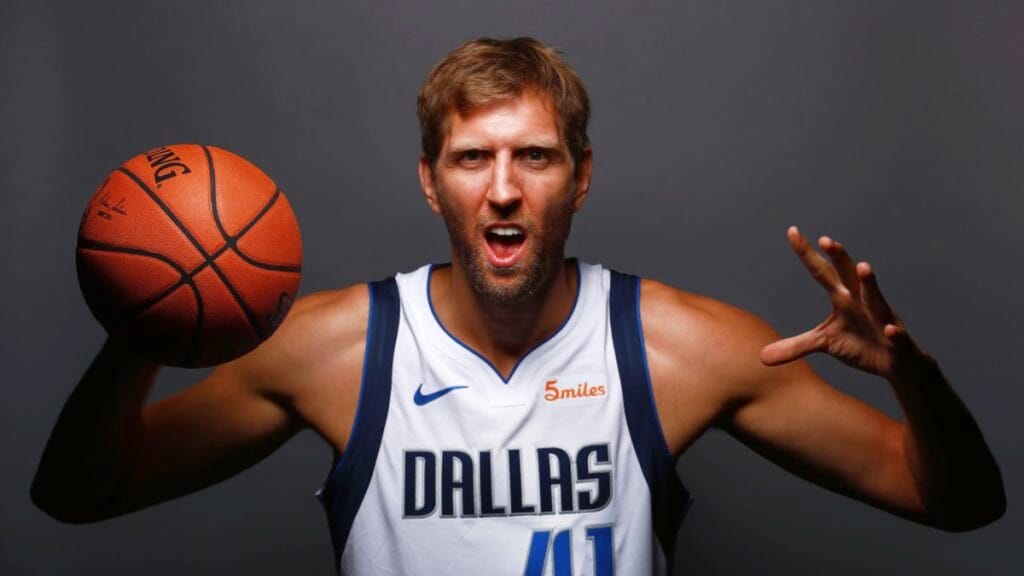
Even in retirement, Nowitzki remains connected to the game. He serves as a special advisor for the Mavericks, providing guidance to players and management. He has also become a respected studio analyst for Prime Video’s NBA coverage, offering his insights and expertise to a new generation of fans. While he has declined the opportunity to be the team’s general manager, preferring his current lifestyle, he continues to be a valuable voice and presence in the basketball world. He also runs the Dirk Nowitzki Foundation, which supports children’s health, education, and social inclusion projects around the world. His life off the court is just as inspiring as his life on it.
His International Career: Germany’s Pride
While his NBA career is what he’s best known for, Nowitzki also had a storied international career with the German national team. He represented his country with immense pride and passion. In 2002, he led Germany to a bronze medal at the FIBA World Championship, a historic achievement for German basketball. He was named the tournament’s MVP, showcasing his dominance on the global stage. In 2005, he led Germany to the silver medal at the EuroBasket tournament, further cementing his legacy as the greatest German basketball player of all time.
He also competed in multiple Olympic Games, including 2008 in Beijing and 2012 in London. He was always the focal point of the German team, and his performances inspired a generation of young German basketball players. His commitment to the national team was unwavering, and he always made himself available for major tournaments. This dedication to his country further enhanced his reputation as a true global ambassador for the sport.
Dirk Nowitzki is more than just a basketball player; he is a cultural icon and a transformative figure in sports history. His journey from Würzburg to the Hall of Fame is a story of talent, hard work, and a singular vision that changed the game of basketball. He redefined what it meant to be a big man, shattered stereotypes about European players, and brought a championship to Dallas through his unwavering determination. His iconic one-legged fadeaway, his loyalty, and his place as the greatest European player of all time are secure. Dirk Nowitzki’s legacy will inspire generations of players to come, proving that with skill and heart, anything is possible. He is, and always will be, a true titan of the game.
Frequently Asked Questions (FAQs)
1. What teams did Dirk Nowitzki play for?
Dirk Nowitzki played his entire 21-year NBA career with one team: the Dallas Mavericks. He was originally drafted by the Milwaukee Bucks but was immediately traded to the Mavericks in 1998.
2. How many points did Dirk Nowitzki score in his career?
Dirk Nowitzki scored a total of 31,560 points over his NBA career, which currently ranks sixth on the NBA’s all-time scoring list. He is the highest-scoring foreign-born player in NBA history.
3. When did Dirk Nowitzki win his NBA championship?
Nowitzki won his only NBA championship with the Dallas Mavericks in 2011, defeating the Miami Heat in the NBA Finals, where he was named Finals MVP.
4. Is Dirk Nowitzki in the Hall of Fame?
Yes, Dirk Nowitzki was inducted into the Naismith Memorial Basketball Hall of Fame in 2023, a well-deserved honor for his legendary career.
5. What was Dirk Nowitzki’s signature move?
His signature move was the one-legged fadeaway jump shot. It was a highly effective shot that he used to create space against defenders and has since become a staple in the NBA.
6. What NBA records does Dirk Nowitzki hold?
One of his most notable records is having the longest tenure with a single franchise in NBA history at 21 seasons. He is also the highest-scoring foreign-born player in NBA history.
7. Where is Dirk Nowitzki from?
Dirk Nowitzki was born in Würzburg, Germany. He represented the German national team in international competition, leading them to a bronze medal in the 2002 World Championships and silver in the 2005 EuroBasket.
8. What is Dirk Nowitzki doing now?
Nowitzki is currently a special advisor for the Dallas Mavericks and works as a studio analyst covering the NBA for Prime Video. He also runs his foundation which supports children’s health and education projects.