Oracle Corporation (NYSE: ORCL) has experienced one of the most dramatic stock market reversals in recent memory. From a peak of $345.72 in September 2025, the stock has plummeted approximately 63%, recently touching a 52-week low of $121.50, This represents a staggering loss of nearly $600 billion in market capitalization, What makes this selloff particularly perplexing is that it has occurred while the company reports record revenue growth, massive cloud infrastructure expansion, and its largest backlog of contracted business in its history.
The Oracle story has become a fascinating case study in market psychology: a company growing its cloud infrastructure business at nearly 100% annually, yet seeing its stock price cut by more than half. The paradox has left many investors wondering whether this represents a generational buying opportunity or a trap. To understand what is happening at Oracle, one must look beyond the headline revenue numbers and examine the company’s balance sheet, capital expenditure plans, and customer concentration risks.
This article explores why Oracle stock is falling, examines the company’s performance on the NASDAQ, analyzes the role of founder Larry Ellison, and assesses whether the AI-driven growth story can ultimately justify the massive spending that has spooked the market.
Oracle Stock Chart and NASDAQ Performance
Oracle Stock Chart and NASDAQ Performance
Oracle’s stock has traded on the NASDAQ under the ticker symbol ORCL. As of July 2026, the share price hovers around $126-$132, down significantly from the $345.72 peak. The stock recently hit a 52-week low of $121.50, reflecting the sustained selling pressure.
The company’s market capitalization has shrunk to approximately $364-$381 billion, a sharp decline from its peak valuation, Despite this, Oracle maintains a price-to-earnings (P/E) ratio of around 21-22 based on trailing earnings, and trades at approximately 16 times forward earnings guidance.
Historical Performance Context
The stock’s 52-week range of $121.50 to $345.72 highlights the extraordinary volatility, Over the past five years, Oracle shares have gained approximately 40%, underperforming the S&P 500’s 74% return over the same period. For perspective, Microsoft (MSFT) rose 43%, while Alphabet (GOOG, GOOGL) advanced 175% during this timeframe, This underperformance has accelerated in recent months as investors have grown increasingly concerned about Oracle’s financial position.
YTD and Recent Performance
YTD and Recent Performance
Year-to-date through mid-July 2026, Oracle stock has returned approximately 34.5%, though this reflects the sharp decline from earlier highs as much as any recovery. The stock’s 1-year return stands at roughly 48.6%, again influenced by the peak in September 2025, However, more recent performance shows a sustained downtrend: in June 2026, Oracle had its worst month since September 1990, with the week ending June 26 representing its worst weekly performance since August 2001.
The selling pressure intensified after the company’s June 10 earnings release. Despite reporting strong quarterly results, the stock fell roughly 10% in after-hours trading and continued its slide for nine consecutive sessions, losing 24% of its value before finding a tentative floor.
Why is Oracle Stock Falling?
Why is Oracle Stock Falling?
The central tension driving Oracle’s stock decline is this: the company is posting record revenue growth while simultaneously burning through unprecedented amounts of cash. In fiscal year 2026, Oracle reported revenue of $67.4 billion, up 17% year-over-year, Cloud infrastructure revenue surged 77% for the year and 93% in the fourth quarter alone.
However, the cost of this growth has been staggering. Oracle spent $55.7 billion on capital expenditures in FY2026, exceeding its own $50 billion guidance, This spending pushed free cash flow to negative $23.7 billion for the year, meaning the company spent nearly $24 billion more than it generated from operations.
To fund this gap, Oracle raised approximately $43 billion in debt and $5 billion in equity during FY2026. The company’s total debt now exceeds $100 billion, For FY2027, management has guided for approximately $70 billion in net capital expenditures and expects to raise another $40 billion through debt and equity financing, including a $20 billion at-the-market equity issuance.
The Credit Rating Concern
In July 2026, S&P Global Ratings downgraded Oracle’s credit rating from BBB to BBB-, leaving the company just one notch above junk status, The downgrade was driven by the massive cost of the AI infrastructure build-out and the resulting deterioration in free cash flow. S&P also noted that Oracle’s concentrated exposure to a single customer OpenAI represents a significant risk.
This rating action sent a strong signal to the market that Oracle’s financial position is under stress. With a credit rating one step above junk and a negative outlook from both Moody’s and S&P, the company faces higher borrowing costs and limited financial flexibility.
Competitive Pressures
Competitive Pressures
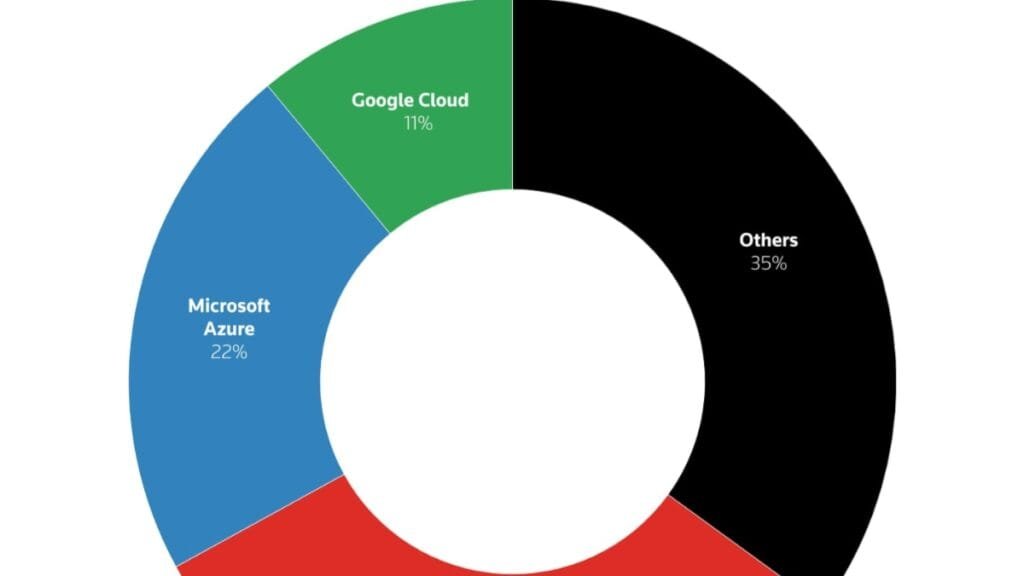
Oracle faces intense competition from established cloud giants including Microsoft Azure, Amazon Web Services, and Google Cloud, While Oracle’s growth rate in cloud infrastructure is superior, its scale remains smaller. AWS generated approximately $116 billion in cloud revenue, Azure about $97 billion, and Google Cloud around $43 billion, compared to Oracle’s $18.1 billion in infrastructure revenue.
The company is attempting to differentiate itself through bespoke, large-scale data center builds tailored to specific customer needs, but this strategy requires enormous upfront capital and compresses margins.
Oracle’s Growth Engine: The $638 Billion Backlog
Oracle’s remaining performance obligations (RPO) contracted future revenue not yet recognized on the income statement reached $638 billion at the end of FY2026, up 363% from the previous year, This figure represents the work Oracle has signed agreements for and is the most cited number in the bullish case for the stock.
The backlog grew by $85 billion in a single quarter, reflecting a surge in AI infrastructure contracts. CEO Clay Magouyrk described the AI infrastructure space as a “trillions of dollars per year” market and cited $67 billion in AI infrastructure contracts booked in the quarter.
The Concentration Risk
The Concentration Risk
However, approximately half of Oracle’s $638 billion RPO is tied to a single customer: OpenAI, This concentration risk is substantial. If OpenAI struggles to fund its commitments, Oracle could be left holding data centers built for demand that never arrives.
OpenAI itself is an unprofitable company that reportedly generated approximately $12 billion in revenue in mid-2025, The company has delayed its IPO to 2027, raising questions about its ability to finance its commitments to Oracle and other infrastructure providers, As one analyst noted, Oracle is building for a customer whose ability to pay depends on that customer’s own fundraising success.
Slow Revenue Conversion
The conversion timeline for the backlog is long. Only about 12% of Oracle’s $638 billion RPO is expected to become revenue in the next 12 months, leaving more than $560 billion spread over several years, This means Oracle is spending on infrastructure today, funded through debt and equity raises, while the cash returns come much later.
Why Oracle Stock Is Up
Why Oracle Stock Is Up (When It Is)
The Bull Case
Despite the steep decline, approximately 86% of sell-side analysts covering Oracle maintain a Buy or Strong Buy rating, The average price target stands at approximately $268.27, representing substantial upside from current levels.
Bullish analysts argue that Oracle’s $638 billion backlog validates the demand for its cloud infrastructure and that the stock is now oversold, Mizuho analysts have set a $400 price target, calling Oracle “grossly undervalued” and predicting a “cash flow waterfall” by FY2029.
The growth of Oracle Cloud Infrastructure (OCI) is genuinely impressive. OCI grew 77% for the year and 93% in the fourth quarter, outpacing competitors’ growth rates, Oracle is also pursuing multicloud partnerships with Amazon Web Services, Google Cloud, and Meta to diversify its customer base.
The Technical Architecture Advantage
Oracle Cloud Infrastructure was rebuilt in 2016 with features that differentiate it from competitors. The platform offers isolated network virtualization and bare-metal compute options, providing stronger security boundaries and more predictable performance, This architecture, combined with “chip neutrality” deploying whichever compute hardware customers request rather than imposing a preferred hardware stack gives Oracle a unique selling proposition in the AI infrastructure market.
The Value Proposition
At current prices, Oracle trades at approximately 16 times the adjusted earnings management has guided for FY2027, This is a valuation more commonly associated with slow-growing legacy software companies than a business guiding for 34% revenue growth, If the backlog converts anywhere near schedule, earnings growth could reaccelerate once the heaviest spending is behind the company.
Oracle Stock and Larry Ellison
Oracle Stock and Larry Ellison: Founder’s Fortune and Influence
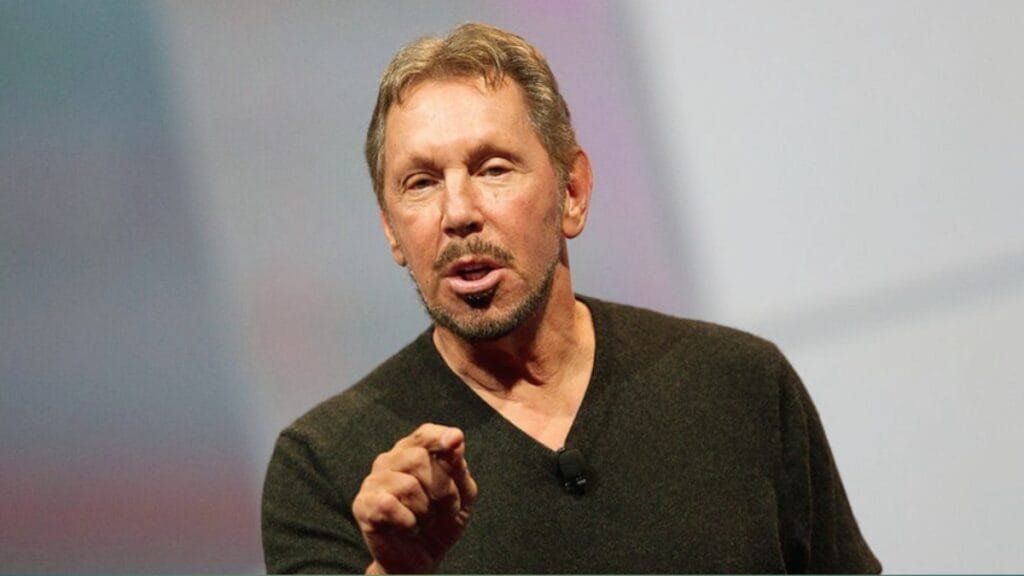
Oracle founder Larry Ellison has been personally affected by the stock’s decline. His net worth peaked near $388 billion in September 2025, briefly making him the second-richest person in the world behind Elon Musk, By July 2026, his fortune had fallen to approximately $175 billion, a decline of roughly $213 billion in under ten months.
The Oracle founder has dropped to No. 8 on the Bloomberg Billionaires Index, The crash has vaporized a substantial portion of his wealth, though he remains one of the wealthiest individuals globally.
Ellison’s Personal Guarantee
Ellison’s personal financial situation is further complicated by his role in a proposed media merger. In February 2026, Paramount Skydance, led by his son David Ellison, announced a deal to acquire Warner Bros. Discovery at an enterprise value of approximately $110-$111 billion, Ellison provided an irrevocable personal guarantee of $40.4 billion of the equity financing, backed by approximately 1.16 billion Oracle shares held in a trust.
With Oracle shares down by more than half since the guarantee was made, the value of the collateral has significantly declined. A coalition of 12 state attorneys general has sued to block the merger, adding further uncertainty, If the deal collapses, Ellison could face a $7 billion regulatory termination fee.
Ellison’s Track Record
Despite the current challenges, Ellison has a long history of successful bets on technology trends. He built Oracle from a small database startup into one of the world’s most valuable technology companies. His decision to pivot aggressively into cloud infrastructure represents another such bet. Whether this bet pays off remains to be seen, but those who have bet against Ellison in the past have often been proven wrong.
The Oracle Dilemma
The Oracle Dilemma
Oracle is simultaneously a company with record operational strength and one with extraordinary financial stress. The company’s revenue, earnings per share, and operating cash flow all hit records in FY2026, Cloud infrastructure revenue grew at an astonishing pace, and the backlog of contracted business is larger than many countries’ GDP.
Yet the cost of this growth $55.7 billion in capital expenditures, negative free cash flow of $23.7 billion, debt exceeding $100 billion, and a credit rating just above junk has spooked the market, The concentrated exposure to OpenAI, a company with its own financial challenges, adds a layer of counterparty risk that has investors concerned.
The Verdict
For investors, the question is whether the current valuation adequately reflects these risks. At approximately 16 times forward earnings, Oracle trades at a significant discount to its historical average and to its peers, If the backlog converts into actual cash flow, today’s price could prove to be a bargain. However, if AI demand softens, OpenAI struggles to fund its commitments, or the spending outpaces returns, Oracle could face further downside.
The market’s skepticism is understandable given the financial structure Oracle has adopted. Unlike Meta and Alphabet, which funded their infrastructure build-outs from operating cash flow, Oracle is relying on debt and equity dilution, This leaves little room for error. As one analyst put it, The fear itself is rational. Negative free cash flow, a credit rating one notch above junk, and half the backlog riding on one unprofitable customer are real risks.
Oracle’s AI bet is a high-stakes gamble. The company is attempting to build hyperscaler-scale infrastructure without the cash generation of a traditional hyperscaler. Whether this strategy succeeds will determine not only the company’s future but also the fortune of its founder and the portfolio returns of its shareholders.
Disclaimer: This content is for educational and informational purposes only and does not constitute financial advice. Stock market investments carry risks, including the potential loss of principal. Always consult a qualified financial advisor before making investment decisions. The author does not guarantee the accuracy or completeness of the information provided. Past performance does not guarantee future results.
रश्मि शर्मा, पत्रकार व लेखिका। 8+ वर्षों का अनुभव।
विशेषज्ञता: नेशनल और अंतरराष्ट्रीय राजनीति, क्रिकेट-ओलंपिक, शेयर बाजार, अर्थव्यवस्था, AI-टेक, विज्ञान, स्वास्थ्य नीति व अर्थव्यवस्था, मनोरंजन।
जटिल खबरों को सरल भाषा में समझाना मेरी पहचान।