Jeremy Grantham, the legendary investor who famously predicted the dot-com crash of 2000 and the 2008 financial crisis, has issued a new, stark warning that is sending ripples through Wall Street. He believes the current artificial intelligence frenzy has created what he calls the biggest investment bubble in U.S. history, surpassing even the excesses of 1929 and 2000. With a potential crash looming that could wipe out trillions in market value, investors are left wondering if history is about to repeat itself on a devastating scale. Is this time truly different, or are we once again dancing on the edge of a financial cliff?
The Man Who Saw It Coming: Who is Jeremy Grantham?
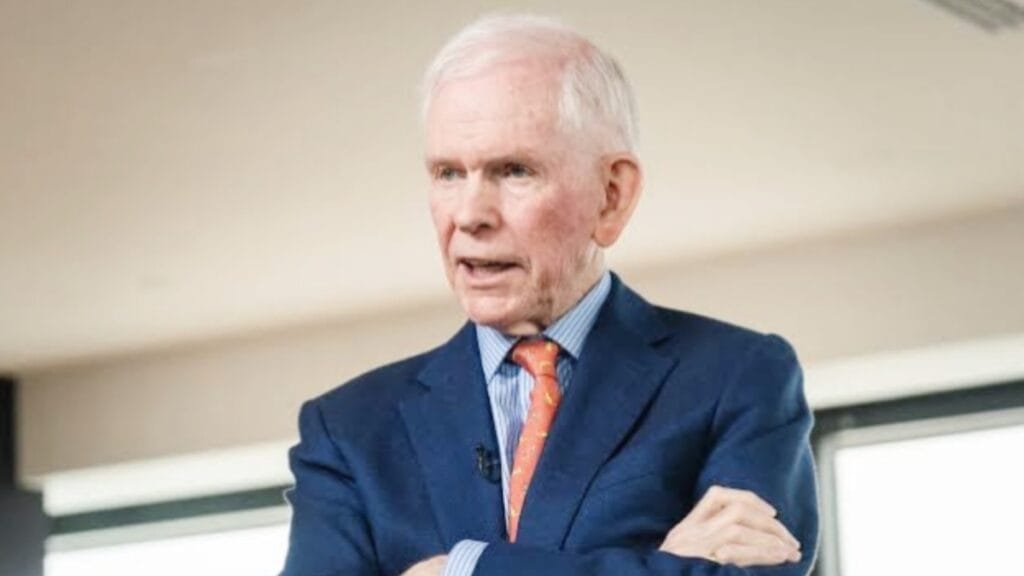
To understand the weight of Grantham’s warning, one must first appreciate his remarkable track record and his unique position in the world of finance. With a career spanning over five decades, Jeremy Grantham is the co-founder and long-term investment strategist of GMO, a Boston-based investment firm managing tens of billions of dollars in assets. He is renowned not just as a money manager, but as a student of market history who has consistently navigated the most turbulent financial waters with uncanny accuracy.
Before the “Super Bubble” warnings of recent years, Grantham had already cemented his legacy as one of the most prescient investors of his generation. He correctly anticipated the Japanese stock market and real estate bubble of the 1980s, which eventually collapsed and led to Japan’s “Lost Decade.” He famously predicted the dot-com collapse of 2000, warning that technology stocks were wildly overvalued long before the Nasdaq crashed by nearly 80%. And he foresaw the housing and subprime crisis that triggered the 2008 Global Financial Crisis, positioning his firm to survive the meltdown while others went bankrupt.
His investment philosophy is grounded in classic value investing and the economic principle of mean reversion, which posits that prices and profit margins eventually return to their long-term averages, regardless of how euphoric or pessimistic the market becomes. This disciplined, data-driven approach has made him a revered figure among value investors, but it has also come at a significant cost. During the late 1990s tech boom, Grantham’s firm, GMO, stuck to its guns and avoided the overvalued tech stocks. As clients watched the market soar to dizzying heights, many became frustrated with GMO’s underperformance, and the firm lost more than half its assets under management. Yet, when the bubble finally burst and the Nasdaq crashed, GMO was spectacularly vindicated, having heavily invested in safer assets like REITs and emerging markets that outperformed during the downturn.
Now, at the age of 86, he is sounding the alarm once again with even greater urgency than before. He describes the current AI market as a “Super Bubble,” a rare statistical event (a 3-sigma event) that has occurred only a handful of times in the last century, including 1929, 2000, and 2021. According to Grantham, we are not just in a regular bull market; we are in the final stages of an epic speculative mania that history will remember for generations.
Artificial Intelligence
The Core Argument: Why AI is the “Classic Bubble” of Historic Proportions
Grantham’s thesis is straightforward yet deeply alarming. In his view, the current enthusiasm for Artificial Intelligence is not just another market cycle; it is a classic asset bubble characterized by extreme overvaluation, speculative mania, and a complete disconnect between stock prices and underlying fundamentals. He places the rise of AI alongside the great infrastructural revolutions of the past, such as the 19th-century railways, the automobile boom of the 1920s, and the internet revolution of the 1990s. However, he warns that such transformative technologies are precisely the foundation upon which the biggest financial bubbles are built. The technology itself may change the world, but that does not mean the stocks associated with it will survive the inevitable bust.
His argument rests on several alarming data points that paint a concerning picture of the current market landscape:
• Extreme Valuations: The U.S. stock market, particularly the S&P 500 and the Nasdaq, is currently trading at historically high multiples. The Shiller CAPE (Cyclically Adjusted Price-to-Earnings) ratio, a key metric that Grantham closely monitors, is well above the long-term historical norms for earnings. This suggests that stock prices are far disconnected from the underlying reality of corporate profitability. Historically, such elevated valuations have preceded significant market corrections.
• A Pervasive Mania: The current market is characterized by a high degree of euphoria, fear of missing out (FOMO), and speculative behavior that is reminiscent of past bubbles. Grantham points to the presence of retail investors in the market, which is at its highest level in modern history. This exposes a massive amount of public savings to a potential correction. Additionally, the surge in options trading, meme stocks, and cryptocurrency speculation indicates that risk appetite has reached dangerous extremes.
• Concentration Risk: The market is becoming dangerously concentrated in a handful of mega-cap technology stocks, often referred to as the “Magnificent Seven.” These companies, including Nvidia, Microsoft, Apple, and Alphabet, now account for an unprecedented share of the total S&P 500 market capitalization. This concentration means that if these AI-driven stocks correct, the entire index will suffer significantly. Grantham warns that such narrow market leadership is historically a sign of a market top.
Furthermore, Grantham draws a direct and haunting parallel to Amazon during the 1999 dot-com bubble. Amazon’s stock multiplied by seven times before collapsing 92% in the crash. He argues that while the AI technology itself may survive and eventually transform the world, the AI stocks of today may not. History, he believes, is playing out on a remarkably similar track: the technology lives on and thrives, but the investor capital that was poured into overhyped stocks is completely destroyed.
SpaceX
SpaceX, Asteroid Mining, and the Specter of the South Sea Bubble
One of the most striking and vivid examples of this speculation, according to Grantham, is Elon Musk’s SpaceX. He uses the private space company as the defining symbol of the current bubble’s peak and the irrational exuberance that has gripped the markets. He points to SpaceX’s prospectus, which identifies its potential total addressable market as a quarter of global GDP and even discusses futuristic opportunities like asteroid mining as a revenue stream.
Grantham warns that such lofty, almost fantastical, projections are the quintessential hallmarks of a speculative mania. They represent a complete departure from realistic financial analysis and instead rely on narratives of infinite growth and technological utopianism. He draws a direct line from today’s hype to one of history’s most famous and devastating financial disasters. He states, “Within 50 years, people will look back and tell stories about SpaceX and its brochure, just as they tell stories about the South Sea Bubble.”
The South Sea Bubble of the 18th century was a massive financial crash triggered by speculation in a company that was granted a monopoly on trade in the South Seas. The company’s stock price soared on unrealistic promises of immense wealth, only to collapse and ruin countless investors. For Grantham, SpaceX’s claims, particularly regarding asteroid mining, represent the same kind of irrational exuberance and detachment from economic reality. The fact that such projections are taken seriously by investors is a clear sign that the market has lost its collective mind.
He predicts that a significant market correction is not just possible but imminent, suggesting that a price drop of up to 70% for high-flying tech stocks tied to the AI narrative is a realistic and likely scenario, given current valuations and historical precedents. This would be a catastrophic event for retail investors who have piled into these stocks at peak prices.
Bitcoin
Useless Nonsense: Grantham’s Stark and Uncompromising View on Bitcoin
Jeremy Grantham is equally critical of the cryptocurrency market, specifically Bitcoin, and his views are as uncompromising as they are controversial. He does not mince words, describing it as “useless nonsense” and a “magnificent way to speculate,” while denying it any real long-term economic utility. His critique is firmly grounded in a classic fundamental value investing perspective that prioritizes tangible assets, cash flows, and intrinsic value.
He rejects the idea that Bitcoin serves as a viable currency or a reliable store of value. He argues that its extreme volatility, pointing to its significant price swings of 30% to 50% in a single year, makes it an unreliable asset for any serious investor. He points out that Bitcoin lacks convenience as a means of exchange, highlighting its limited adoption for everyday transactions and its high energy consumption. He also notes that its primary use case appears to be facilitating illicit transactions, which further undermines its legitimacy as a mainstream financial asset.
Perhaps most controversially, Grantham does not see a long-term future for Bitcoin at all. When asked directly about Bitcoin’s long-term prospects, he stated that it will “certainly go to zero” in the distant future. He notes that although this may take a long time, it is an inevitable outcome because Bitcoin generates no earnings, pays no dividends, and has no underlying asset backing it. In a provocative and memorable statement, he concluded, “In the distant future, everything goes back to zero.” For Grantham, Bitcoin represents the ultimate speculative asset, devoid of any fundamental value, and its eventual collapse is a mathematical certainty.
The Grantham Portfolio: 60% Non-U.S. Stocks, Bonds, and Gold
So, if Grantham believes a catastrophic crash is coming, what is he advising investors to do to protect their wealth? He is offering a clear, actionable, and decisive strategy for capital preservation in the face of what he sees as an inevitable downturn. He recommends a complete and radical overhaul of the traditional, U.S.-centric portfolio that most American investors rely on.
Grantham’s advice is specific, data-driven, and unconventional:
1. Avoid U.S. Stocks Entirely: “Do not hold U.S. stocks. It’s a simple strategy you can act on,” he states bluntly. He believes that the risk-reward ratio in the U.S. market is so unfavorable that it is simply not worth the exposure. He advises investors to completely exit their positions in U.S. equities.
2. Go International: He advises allocating approximately 60% of savings into a broad index of non-U.S. equities. This includes developed markets in Europe, Japan, Canada, and Australia, as well as emerging markets like China, India, and Brazil. He points to the impressive performance of emerging markets and their lower valuations as evidence of better value elsewhere. He argues that international markets are not as overvalued and offer better growth prospects.
3. Hedge with Safe Havens: The rest of the portfolio should be oriented toward protection against a market crash. Grantham recommends investing in short-term government bonds, particularly Treasury Inflation-Protected Securities (TIPS), which offer a safe return and protection against inflation. He also advocates for holding precious metals like gold and silver as a hedge against currency debasement and market volatility. Additionally, he suggests real estate as a tangible asset that can provide income and protection against inflation.
This strategy is a radical departure from the ‘buy the dip’ and ‘stay fully invested’ mentalities that have dominated Wall Street for the last decade. It suggests that the greatest opportunity for investors lies not in fighting the U.S. market, but in seeking value overseas and protecting capital through traditional safe havens. For Grantham, the current valuations in the U.S. simply do not justify the enormous risk. He is effectively telling investors to prepare for a storm, rather than trying to ride it out.
Jeremy Grantham’s warning
Jeremy Grantham’s warnings carry immense weight and should not be dismissed lightly. Having successfully navigated the market’s most turbulent periods by identifying bubbles before they burst, his voice serves as a stark and necessary reminder of the cyclical nature of financial markets. His 2026 warning centers on the belief that the transformative promise of Artificial Intelligence has created a “Super Bubble” of historic proportions, where stock prices are dangerously disconnected from economic reality.
He points to speculative symbols like SpaceX’s grand ambitions as indicators of a market top, compares the frenzy to the South Sea Bubble, and explicitly rejects Bitcoin, calling it “useless nonsense.” The path Grantham recommends is a clear and decisive one: exit U.S. stocks, diversify heavily into international markets, and protect your capital with bonds and precious metals. Whether he is proven right or wrong remains to be seen, but as history has repeatedly shown, ignoring a permabear with his extraordinary track record might be the most dangerous gamble of all. The market’s final act may be yet to come, and according to Jeremy Grantham, it will be a tragedy of epic proportions.